
“One of the most important voices to follow in today’s Latin American music.” — Scherzo Magazine
Born in Lima, Juan Arroyo is a Franco‑Peruvian composer whose work explores the zones where worlds touch, deform, and contaminate one another. Nourished by Peru’s oral traditions, Latin American narratives, and an early fascination for sonic materials, he develops a form of magical sonic realism where technology, ritual, imagination, and dramaturgy intertwine. His first pan flute, the popular songs of his childhood, and the soundscapes of his native country shaped an organic relationship to sound that remains central to his writing.
After studying at the National University of Music of Peru, where he co‑founded the Peruvian Composition Circle in 2001, a key force in contemporary creation in the country, he moved to France in 2004. He continued his training at the Conservatoire de Bordeaux and later at the Conservatoire National Supérieur de Musique et de Danse de Paris, where he was awarded a First Prize in composition. His artistic development was shaped by major figures such as Allain Gaussin, Brian Ferneyhough, Heinz Holliger, Henri Pousseur, Mauricio Kagel, Michael Levinas, Luis Naón, and Stefano Gervasoni, as well as formative experiences at Voix Nouvelles and IRCAM.
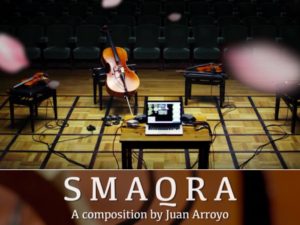
Artist‑in‑residence at prestigious institutions: IRCAM, Centre Henri Pousseur, Cité Internationale des Arts, Casa de Velázquez, Villa Medici, Centre Art Zoyd, he deepened a singular sonic research combining instrumental hybridization, technological dramaturgy, and a profoundly global imagination shaped by the encounter of cultures, sounds, and narratives. In 2014, he composed Smaqra, the first hybrid string quartet, and developed — with acoustician Adrien Mamou‑Mani, the Tana Quartet, and luthier Lucas Balay — the TanaInstruments, pioneering devices that transform traditional lutherie into a field of acoustic innovation.
Recipient of major international awards: the Salabert Foundation Prize for Selva (2013), the Académie des Beaux‑Arts Prize and the Ibermúsicas Prize for Phani Song (2022), he has built a vast and multifaceted body of work: orchestral music, solo pieces, mixed and electroacoustic works, vocal music, installations, and transdisciplinary projects. His works have been performed by leading ensembles such as the Ensemble Intercontemporain, 2e2m, Court‑Circuit, Fractales, L’Itinéraire, Linea, LAPS, L’Arsenale, Proxima Centauri, Sonido Extremo, Vertixe Sonora, the Tana Quartet, and the National Orchestra of Peru, Symphonic Orchestra of Arequipa and Symphonic Orchestra of Cusco, and featured in major festivals including Donaueschingen, Ars Musica, Présences, MAD, Les Musicales d’Assy, Ensemble(s), and Nouveaux Horizons.
His music has been performed in internationally renowned venues, including the Concert Hall of the Cité de la musique – Philharmonie de Paris, Studio 104 at Radio France, Flagey in Brussels, the Palau de la Música de Valencia, and the Auditorio 400 of the Museo Reina Sofía in Madrid. It has also resonated in emblematic spaces of contemporary creation such as the Villa Medici, the Casa de Velázquez, the Grand National Theatre of Peru, the Centro Cultural de España, and the Salle Antoine‑Vitez in Bordeaux, affirming an ever‑expanding international presence.
His work extends to visual arts and immersive forms. His installations: Paysage Sonore (Baelo Claudia Archaeological Museum, Casa de Velázquez) and Listen to me (Villa Medici, Take me, I’m yours), reveal a multidimensional approach in which sound becomes space, matter, and narrative. His collaboration with visual artist Vincent Ciciliato and the ensemble Proxima Centauri has led to interdisciplinary works such as Sabia Virtual Reality, presented at the MAD Festival (2023), Festival Pléiades (2024), and UNESCO’s Week of Sound (2025).
As a conductor, he studied with Fernando Valcárcel, principal conductor of the National Orchestra of Peru, and is regularly invited to conduct the orchestras of Arequipa and Cusco. Since 2013, he has shaped the artistic identity of Ensemble Regards as its musical director.
Today, Juan Arroyo is composer‑in‑residence with the National Orchestra of Peru, artistic and musical director of Ensemble Regards and the Sonomundo Festival in Paris, and artistic director of the Experimenta Festival in Lima. He also maintains an active pedagogical career: professor at the Conservatoire d’Argenteuil (2019–2023), at the National University of Music of Peru (2024), guest lecturer at the Académie Mixte in Nouvelle‑Aquitaine (2022–2026), and invited composer at institutions such as the Conservatorio di Musica Santa Cecilia (Italy), the Conservatorio de Valencia (Spain), and the Conservatoire de Bordeaux (France). He currently teaches at the Conservatoire Jean‑Baptiste Lully.
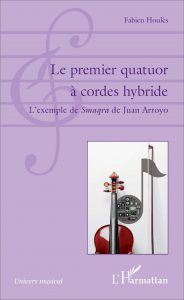
“Juan Arroyo has synthesized his work on hybridization around three fundamental areas concerning perceptual indices: gesture, space and timbre. Hybridization is at the heart of the scrambling of these indices. The expression “causal listening” encompasses different listening situations.
On the subject of his hybrid string quartet, SMAQRA, although the original musical object is part of a percussive timbre, the listening codes refer us to stringed instruments. The singularity and the interest of this work are these games of displacement, of movement between a causal listening and a reduced listening passing by many intermediate states of perception. Juan Arroyo explores different degrees by gradually blurring sound sources like a photographer or a cameraman making us travel from the concrete to the abstract, from materiality to immateriality by the game of the development of its objective.
Thus, the search for the development of reduced listening, favored in a general way by the electronics, constitutes a trajectory towards the unheard-of which the border between sound reality and unrealism is in total correlation with the literary inclinations of Juan Arroyo on the realism Magic.”
FABIEN HOULÈS
Profesor Agregado de la Universidad Jean Monnet de Saint Étienne. Le premier quatuor à cordes hybride, l’exemple de Smaqra de Juan Arroyo, publicado en la primavera de 2017 por la editorial L’Harmattan.